
CCONSTRUCTION INSIGHTS
A practical look at the AIA's first standard agreement created specifically for Owner's Representative services - and what it means for construction project owners.
Why Did the AIA Create the C104 Agreement?
Why Did the AIA Create the C104 Agreement?
Construction projects involve substantial financial commitments, complex contractual relationships, and decisions that can affect an owner's investment for years to come. Architects, engineers, contractors, and construction managers each perform important functions, but their responsibilities do not necessarily include providing independent guidance across every aspect of the project.
For owners without extensive construction experience - or those managing projects alongside their normal business responsibilities - understanding the information presented by these professionals can be challenging.
An Owner's Representative helps bridge that gap by providing experienced guidance, reviewing project information, identifying potential concerns, and assisting the owner in making informed decisions.
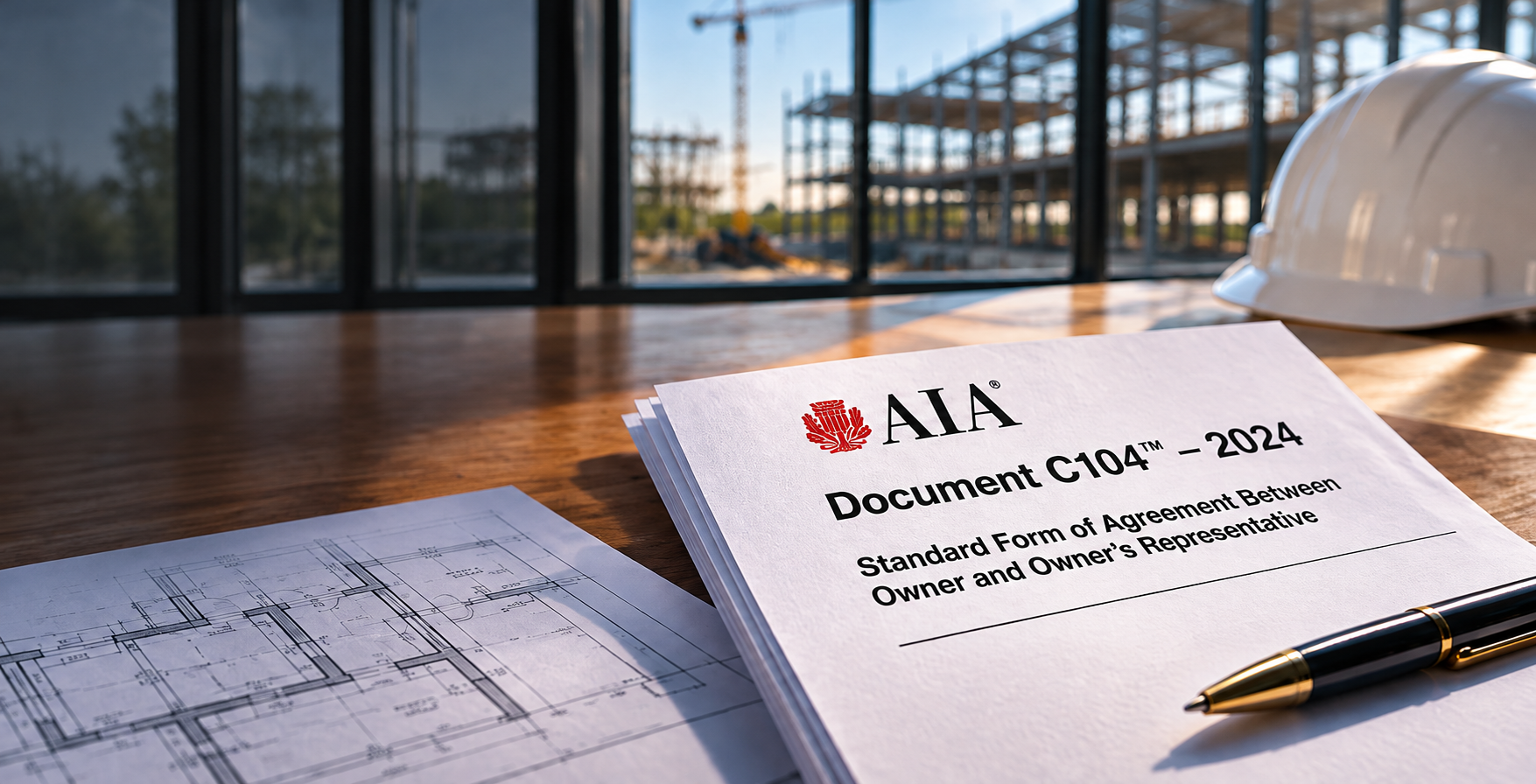
In 2024, AIA Contract Documents introduced AIA Document C104-2024, Standard Form of Agreement Between Owner and Owner's Representative, establishing a dedicated contractual framework for these advisory services.
Understanding why this agreement matters begins with understanding the role it is intended to define.
Why Was a Dedicated Agreement Needed?
Owner's Representation is not a new concept. Public agencies, healthcare systems, educational institutions, private developers, and other organizations have long engaged construction professionals to help manage the complexities of their projects.
However, the responsibilities assigned to an Owner's Representative can vary considerably.
One owner may need assistance evaluating design proposals and developing a realistic project budget. Another may require regular construction observations, schedule monitoring, payment application reviews, or coordination between multiple project participants.
Without a clearly defined agreement, expectations can become inconsistent.
Who is responsible for monitoring the project budget? How frequently should the representative attend meetings? What reports should the owner receive? Can the representative make decisions on the owner's behalf?
These questions should be addressed before services begin.
C104 provides a standardized starting point for defining the relationship between the owner and the professional engaged to represent the owner's interests.
Rather than leaving the entire scope of services to be developed from scratch, the agreement establishes a framework for responsibilities, services, compensation, communication, and contractual limitations.
An Advisory Role, Not a Replacement for the Project Team
One of the most important principles behind C104 is the distinction between providing professional advice and assuming another project participant's contractual responsibilities.
The architect remains responsible for the professional services established by the owner-architect agreement. The contractor remains responsible for performing the construction work according to its contract.
The Owner's Representative serves a different purpose.
The representative assists the owner in understanding project information, evaluating potential concerns, monitoring progress, and coordinating matters that require the owner's attention.
Consider a project where the contractor reports that an unforeseen condition will increase costs and delay completion.
The architect may evaluate the technical implications. The contractor may submit a proposed change order and schedule adjustment.
The Owner's Representative can assist the owner by reviewing the supporting documentation, evaluating the proposed cost and schedule impacts, identifying unanswered questions, and helping the owner determine what additional information is needed before making a decision.
The value is not in replacing the judgment of the architect or contractor. It is in helping the owner exercise informed judgment.

The Critical Difference Between Responsibility and Authority
Perhaps the most important feature of C104 is its treatment of the Owner's Representative's authority.
Article 2 establishes the representative's responsibilities and limitations on acting on the owner's behalf.
That distinction matters because an individual may be responsible for reviewing project information without having the contractual authority to approve or change it.
For example, an Owner's Representative may be asked to:
Evaluate a proposed change order and provide a recommendation.
Review a payment application and identify potential discrepancies.
Monitor the construction schedule and report concerns.
Participate in project meetings and communicate issues requiring the owner's attention.
Assist the owner in evaluating matters affecting project cost, schedule, or completion.
These activities should not automatically be interpreted as authorization to approve changes, direct construction activities, or commit the owner financially.
Authority must be established through the applicable agreements and any properly documented delegation.
This is especially important when multiple AIA documents are used on the same project.
Some AIA agreements contemplate an owner's designated representative having broad authority to act on the owner's behalf. C104, however, establishes a more limited advisory role.
AIA specifically cautions users to obtain legal guidance before identifying a C104 Owner's Representative as the owner's representative under another AIA agreement.
An Owner's Representative's responsibilities and decision-making authority must be clearly understood by everyone involved in the project.
That clarity helps protect the owner, the representative, and the other project participants from conflicting expectations.
Defining What the Owner's Representative Actually Does
Article 3 of C104 establishes the scope of the Owner's Representative's Basic Services.
According to AIA's published instructions, these services generally address activities throughout project initiation, design, procurement, construction, and closeout.
They include consulting with the owner, assisting with the project budget and schedule, participating in meetings, preparing periodic reports, and coordinating closeout activities.
These services support a basic principle of effective project oversight: the owner needs reliable information throughout the project, not simply when a major problem develops.
A construction budget must be monitored as decisions are made.
A project schedule must be reviewed as activities progress.
Potential concerns should be communicated while there is still an opportunity to address them.
Regular reporting helps the owner understand whether the project is progressing as expected and which decisions require attention.
C104 also establishes a framework for defining the number of in-person meetings included in Basic Services and the frequency of status reporting.
These details may seem administrative, but they directly influence the owner's expectations and the level of service being provided.
Why Supplemental and Additional Services Matter
Not every construction project requires the same level of representation.
A relatively straightforward renovation may require periodic consultation and progress reviews. A large healthcare or institutional project may involve more extensive coordination, reporting, and oversight requirements.
Article 4 addresses Supplemental and Additional Services, allowing the parties to identify services beyond the established Basic Services and address circumstances requiring additional compensation.
This distinction is important for both parties.
The owner needs to understand which services are included in the original agreement and which may require additional authorization or compensation.
The Owner's Representative needs a clearly established scope to allocate resources, maintain appropriate staffing, and perform services consistent with contractual expectations.
Compensation and Contractual Expectations
C104 also addresses compensation, claims and disputes, termination or suspension, and other terms governing the relationship.
Article 9 provides a framework for establishing compensation for the representative's services.
AIA identifies several possible compensation approaches, including stipulated sums, hourly billing rates, and methods based on personnel costs or expenses.
The appropriate method depends on the nature of the project, its anticipated duration, the services required, and the agreement between the parties.
AIA does not prescribe a universal fee or recommend one compensation method for every project.
What matters is establishing a compensation structure that is clearly understood and consistent with the agreed scope of services.
Just as importantly, the agreement should address what happens when project conditions change, services extend beyond the anticipated duration, or either party needs to suspend or terminate the relationship.
These provisions are not merely administrative details. They help establish the expectations under which professional services will be performed.
What Does C104 Mean for Construction Owners?
C104 does not eliminate construction risk, guarantee project performance, or transfer responsibility for the project to an Owner's Representative.
Its importance lies in creating a more clearly defined professional relationship.
For an owner considering representation, the agreement encourages several practical questions:
What services does the owner need throughout the project?
What authority, if any, will the representative have?
How will the representative communicate concerns and recommendations?
What reports and documentation will the owner receive?
How will services and compensation change if the project extends beyond its anticipated schedule?
Answering these questions before entering into an agreement can establish a stronger foundation for the relationship.
The objective is not to add unnecessary administrative complexity. It is to ensure that professional expectations are established, responsibilities are understood, and the owner receives the guidance needed to make informed decisions.
The ACG Perspective
At Adkins Construction Group, we believe effective Owner's Representation begins with clearly defined expectations and an understanding of how construction projects actually function.
Construction decisions rarely occur in isolation. A design revision can affect the budget. A delayed material delivery can affect the schedule. An incomplete scope can lead to changes that affect both cost and completion.
Recognizing these relationships requires practical experience and an understanding of the responsibilities of the professionals involved.
AIA C104 provides a useful framework for defining how an Owner's Representative contributes to that process.
The agreement does not replace experience, communication, or professional judgment. It helps establish the contractual foundation for applying them effectively.
Key Takeaways
AIA C104-2024 represents an important development in establishing clear contractual expectations for Owner's Representative services.
The essential points are straightforward:
Defined responsibilities: The agreement establishes a framework for the services the representative will provide.
Limited authority: Providing advice and oversight does not automatically grant authority to make binding decisions for the owner.
Clear service expectations: Basic, Supplemental, and Additional Services help define the anticipated level of involvement.
Established compensation: The parties determine an appropriate compensation structure based on the agreed services.
Better-informed ownership: Clear communication and experienced guidance help owners evaluate project information and make informed decisions.
For construction owners, understanding these distinctions is an important first step toward establishing an effective Owner's Representative relationship.
Continuing the Construction Insights Series
Our next Construction Insight examines Article 1 of AIA C104-2024: Initial Information, including the project details, budget, schedule, and other foundational information that should be established before services begin.
Reference
American Institute of Architects / AIA Contract Documents. Instructions: C104-2024, Standard Form of Agreement Between Owner and Owner's Representative.
This article provides general educational information and does not constitute legal advice. AIA C104 is a copyrighted contract document. Parties considering its use should obtain the official agreement and consult qualified legal counsel regarding project-specific terms and applicable laws.

How Can We Help With Your Project?
Adkins Construction Group provides specialized professional services and considers individual construction-related assignments based on project needs, scope, and availability.